
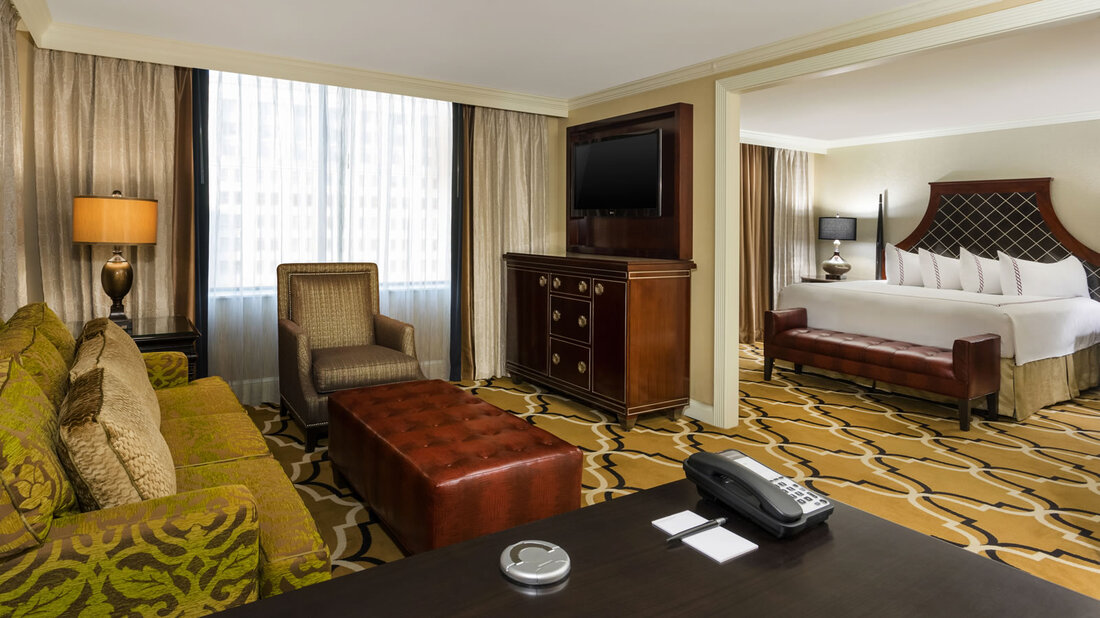
Booking a hotel room should be simple, but the names on the booking page rarely make it simple. Standard, deluxe, superior, suite, studio, one-bedroom: the words sound straightforward, yet the same word can mean very different rooms at different hotels. A "deluxe" room at one hotel might be barely bigger than a standard room at another. A "suite" might be a genuinely separate living area, or just a slightly larger room with a sofa.
This guide explains what the main room types usually mean, what to check before you pay, and how the differences play out at two real Orlando airport hotels: the in-terminal Hyatt Regency Orlando International Airport and the nearby Hyatt House Orlando Airport. Once you know what to look for, you can stop guessing from room names and start booking the room you actually want.
Standard Rooms: The Baseline
A standard room is the hotel's entry-level room. It is the basic unit everything else is compared against: a bed or beds, a private bathroom, a desk or work area, a television, Wi-Fi, and climate control. It is designed to cover the essentials well, without extra space or special features.
At the Hyatt Regency inside Orlando International Airport, the Standard King Room and Standard Two-Queen Room are each around 360 square feet, with a king bed or two queen beds, a work desk, a television, complimentary standard Wi-Fi, a beverage cooler, and coffee and tea facilities. That is a comfortable, well-equipped room for one or two travelers, or a family that needs two beds, and it is the right choice for a straightforward overnight stay before an early flight or between connections.
At Hyatt House Orlando Airport, the equivalent baseline is the Den Guestroom. The Den King is around 314 square feet and the Den Two-Queen around 348 square feet, each with a mini-refrigerator, a microwave, a coffee maker, a work area, and free Wi-Fi. The key point here is that these are standard rooms, not suites: they give you basic food storage and reheating, but not a full kitchen.
Standard rooms suit most short stays. If you are sleeping, showering, and leaving, you do not need more. Where standard rooms fall short is on longer stays or trips where several people share the room. There is limited space to spread out, limited storage, and no separate area for one person to work while another rests. If that sounds like your trip, the next categories up are worth the difference.
Deluxe Rooms: More Space, Better Position, or Both
Deluxe is the most confusing word in hotel booking, because it does not have one fixed meaning. In general, a deluxe room is a step above standard: larger, better located, better equipped, or some combination of the three. The only way to know which is to check what the specific hotel says about its own deluxe rooms.
At the Hyatt Regency Orlando International Airport, the difference is mostly about space. The Deluxe King Room is around 505 square feet, compared with around 360 square feet for the Standard King. That is roughly 40 percent more floor area, which shows up as a larger layout and a proper seating space rather than just a bigger bed. For a traveler who wants room to work, relax, or spread out luggage without tripping over it, that extra space is the whole point.
Deluxe can also mean position or view rather than size. The same hotel offers high-floor king and two-queen rooms for guests who prefer to be away from the lower levels, runway-view rooms for travelers who enjoy watching airport activity, and balcony and patio rooms that add private outdoor space. A Two-Queen Patio Room, for example, is around 450 square feet with outdoor patio access, which suits families who want fresh air without booking a full suite. None of these are "better" in an absolute sense. They are better for a particular preference, which is why it helps to know your own before you book.
The practical lesson is simple: never pay for "deluxe" on the name alone. Compare the room size, the layout, and the features against the standard room at the same hotel. If the deluxe room is larger, has a seating area, or has the view or floor you want, it may be worth it. If the only difference is a vague promise of an upgrade, it probably is not.
Suites: When a Room Becomes a Living Space
A suite is where a hotel room stops being just a bedroom and starts being a place you can live in. The defining feature of a true suite is separation: a living or seating area that is distinct from the sleeping area. In a studio suite, that separation is open-plan, with a seating area at one end of a larger room. In a one-bedroom suite, there is a door between the bedroom and the living room, which gives real privacy.
The Hyatt Regency's suites show both kinds. Its Two-Queen Studio Suite is around 675 square feet with a spacious layout and a living and seating space alongside two queen beds. Its One-Bedroom Suite is around 600 square feet with a separate bedroom and a living room. Both give you far more room than a standard 360-square-foot room, and the one-bedroom version adds the privacy that matters when two people keep different schedules or when one person needs to work while the other sleeps.
Hyatt House Orlando Airport shows the other side of suites: the kitchen. Its Studio Kitchen Suites, around 405 square feet for the king version and 522 square feet for the two-queen version, include a full kitchen with a full-size refrigerator, a dishwasher, a microwave, and a stovetop, plus a sofa bed and a seating area. Its One-Bedroom Kitchen Suites, around 455 to 518 square feet, add a separate bedroom to the same full-kitchen setup, and the two-queen one-bedroom version sleeps up to five guests. For families and longer stays, that combination of a kitchen, a living area, and a separate bedroom is what makes a suite worth paying for.
The important distinction is between a suite and a slightly larger room. A genuine suite gives you a living area you can use independently of the bed. If a listing calls something a suite but the description shows only a bigger room with a sofa against the wall, treat it as a large standard room and compare it on that basis.
The Kitchen Question
One of the most useful things to check in any room description is the kitchen setup, because the words used for it vary and the difference matters.
A standard or deluxe room typically has, at most, a mini-refrigerator and a coffee maker, sometimes with a microwave. That covers drinks, snacks, and reheating, which is plenty for a night or two. The Hyatt Regency's standard rooms follow this pattern with a beverage cooler and coffee and tea facilities, and Hyatt House's Den rooms add a mini-refrigerator and microwave.
A suite at an extended-stay hotel usually goes much further: a full-size refrigerator, a stovetop, a dishwasher, and proper food-preparation space. Hyatt House's kitchen suites are the clear example, with full kitchens that let you cook real meals rather than just reheat them. For a stay of several nights, that changes the economics of the trip, since cooking even a few meals a week costs far less than eating out for every meal.
Before you book, check exactly which one you are getting. "Kitchenette" can mean anything from a mini-fridge to a nearly full kitchen, depending on the hotel. Confirm the fridge size, whether there is a stovetop or only a microwave, and whether cooking equipment is provided. If you plan to cook, this is the single most important line in the room description.
What the Names Do Not Tell You
Room names hide almost as much as they reveal, so here are the details that are worth checking in every listing, whatever the room is called.
First, bed configuration and occupancy. A room that sleeps two on paper may sleep four with a sofa bed, but a sofa bed is not the same as a real bed, especially for adults. Check the bed types, whether a sofa bed is included, and the maximum occupancy. Hyatt House's one-bedroom two-queen kitchen suite, for instance, is listed for up to five guests because it combines two queen beds with a sofa bed, which is genuinely useful information for a family of five.
Second, size. Square footage is the most honest comparison between room types, because it does not depend on marketing words. A standard room at 360 square feet, a deluxe at 505, and a studio suite at 675 tell you more in three numbers than the names alone ever will. Not every hotel publishes sizes, but when they do, use them.
Third, view and floor. A runway-view, high-floor, balcony, or patio room costs more because of where it is, not because it is bigger. That premium is worth it only if you personally value the view, the quiet of a higher floor, or the outdoor space. If you do not, a standard room on any floor gives you the same bed for less.
Fourth, accessible rooms. Both Orlando hotels offer accessible configurations, including roll-in showers and accessible bathtubs, but the exact features vary by room type. If you need a specific accessible bathroom or layout, book that exact room category rather than a standard room with a request attached, since requests cannot always be guaranteed.
Finally, what is included in the rate. Breakfast, parking, and Wi-Fi can each be included or charged separately, and they differ between these two hotels: Hyatt House includes complimentary breakfast and Wi-Fi but charges for self-parking, while the Hyatt Regency's breakfast generally costs extra and its parking is paid airport parking. When you compare room types across hotels, compare the full cost of the stay, not just the nightly rate.
Studio, One-Bedroom, and Two-Bedroom Suites: What's the Difference?
Within suites, there are subtypes worth knowing, because they describe how the space is divided rather than just how big it is.
A studio suite is one open space with a sleeping area at one end and a living and seating area at the other, sometimes with a kitchen along one wall. There is no door between the bed and the sofa. Studio suites suit solo travelers, couples, and small families who want extra space and a kitchen but do not need a separate bedroom. The Hyatt House studio kitchen suites and the Hyatt Regency two-queen studio suite both follow this pattern, with the living area built into the same open room as the beds.
A one-bedroom suite adds a door. The bedroom is its own room, and the living room is a separate space with its own seating and often its own television. That door is worth more than it sounds: one person can sleep while another works or watches television, and the suite feels like a small apartment rather than a large room. The Hyatt Regency one-bedroom suite and the Hyatt House one-bedroom kitchen suites both offer this layout, and for longer stays or for two adults keeping different hours, it is usually the most comfortable option short of a full apartment.
A two-bedroom suite, where it exists, adds a second bedroom to the same idea and suits larger families or two couples traveling together. Not every hotel offers one, and where they do, they are usually the most expensive standard category below presidential or premium suites. If your group is large enough to need two bedrooms, compare the two-bedroom suite against booking two standard rooms, since two rooms sometimes work out cheaper and give everyone a private bathroom.
How to Choose for Your Trip
The right room type depends on your trip more than on the hotel. A few simple rules cover most cases.
For a single overnight, especially before an early flight, a standard room is almost always enough. At Orlando International Airport, that is exactly the situation the in-terminal Hyatt Regency is built for: you walk from the terminal to a comfortable standard room, sleep, and walk back to your gate. Paying for a suite you will use for eight hours rarely makes sense.
For two to four nights with one or two travelers, a deluxe room is often the sweet spot if the extra space or the view matters to you. The additional floor area makes the room more comfortable without jumping to suite prices, and a high-floor or runway-view room can make the stay more pleasant for a modest premium.
For families, groups, or stays of five nights or more, a suite usually earns its price. The living area gives everyone space, the kitchen cuts food costs, and the separate bedroom in a one-bedroom suite gives adults privacy while children sleep. At Hyatt House, the kitchen suites are designed for exactly this, and the free breakfast adds further value for families.
For working trips, prioritize the workspace and the Wi-Fi over the room name. A standard room with a proper desk, enough outlets, and reliable Wi-Fi beats a larger room with a poor work setup. If you will be on calls all day, a one-bedroom suite has the added advantage of a door you can close.
Booking Tips That Save Money and Surprises
A few habits will protect you whatever room type you choose. First, book the exact room category you want, not just the hotel. "Run of house" or a general room booking can land you in any available category, which is fine if you are flexible and frustrating if you counted on a kitchen or a second bed.
Second, read the room description, not just the headline. Check the bed configuration, the room size if it is given, the kitchen setup, and the view or floor. Photos help, but they can flatter a room, so the written description is the more reliable guide.
Third, compare the total cost. Add the nightly rate, taxes and fees, parking, breakfast, and any other extras you will use, then compare that total across room types and hotels. A suite that looks expensive can work out close to a standard room once breakfast and food savings are counted, and a cheap standard room can become expensive once parking and breakfast are added.
Fourth, check the cancellation terms for the rate you choose. The lowest rate for a room is usually the least flexible, while slightly higher rates can include free cancellation or pay-at-property options. If your plans could change, flexibility is often worth the difference, particularly for a longer or more expensive stay.
Finally, confirm anything unusual directly with the hotel before arrival: an accessible configuration, a specific bed setup, a quiet floor, or an early check-in. A short message at booking time prevents most check-in disappointments, and hotels are generally glad to confirm a detail that matters to you.
Final Word
Standard, deluxe, and suite are not grades of quality. They are descriptions of space, layout, and features, and the same word means different things at different hotels. A standard room is the well-equipped baseline. A deluxe room adds space, position, or view. A suite adds a living area, and at extended-stay hotels, often a full kitchen as well.
Use the numbers when they are available, read the room description rather than trusting the name, and match the room to your trip: standard for a quick overnight, deluxe for extra comfort on a short stay, and a suite when space, a kitchen, or a separate bedroom will genuinely improve your trip. Do that, and the room you book will be the room you actually wanted.
